
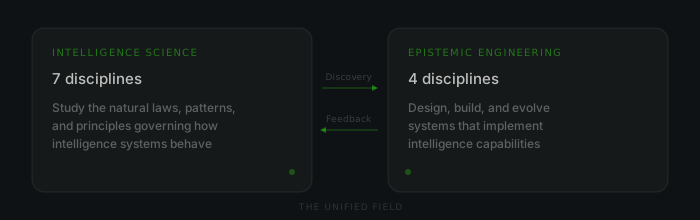
Intelligence Engineering is a unified field comprising seven scientific disciplines and four engineering disciplines. Intelligence Science studies the laws governing intelligence systems. Epistemic Engineering builds systems that implement intelligence capabilities. Together, they create a blueprint for living knowledge ecosystems that evolve, adapt, and compound intelligence across human and artificial boundaries.
1. The Birth of a New Discipline: Intelligence Engineering
1.1 Definition and Necessity
Intelligence Engineering emerged as a response to the contemporary knowledge crisis - a crisis characterized by the exponential growth in information production without corresponding advances in structural coherence, semantic integrity, or evolutionary capacity. While our ability to generate information has expanded dramatically, our capacity to maintain its meaning and enable its productive evolution has not kept pace.
Intelligence Engineering addresses this fundamental gap through a unified approach that integrates scientific understanding with engineering practice:
-
Intelligence Science: The systematic study of natural laws, patterns, and principles governing how intelligence systems acquire, represent, validate, utilize, and evolve knowledge. It investigates knowledge structures, dynamics, and emergent properties across human, artificial, and hybrid contexts through empirical observation, theoretical modeling, and pattern identification.
-
Epistemic Engineering: The applied discipline focused on designing, building, maintaining, and evolving intelligence systems that reliably implement desired cognitive capabilities. It applies principles discovered by Intelligence Science to create architectures, mechanisms, and solutions that enable knowledge to maintain meaning, utility, and evolutionary capacity across time, contexts, and system boundaries.
The Science/Engineering distinction creates explicit knowledge flows:
- Science→Engineering Flow: Scientific discoveries about intelligence principles inform engineering design choices, constraint identification, and system architecture
- Engineering→Science Feedback: Engineering implementations generate new research questions, validate theoretical predictions, and reveal previously unknown patterns in intelligence behavior
The necessity of this unified field arises from several critical observations about our current knowledge landscape:
- Semantic Dissolution: Knowledge increasingly loses meaning as it moves across contexts, agents, and time
- Integration Failure: Knowledge fragments remain disconnected across specialized domains and systems
- Structure-Memory-Interaction Misalignment: Systems prioritize one element (usually structure) at the expense of others
- Recursion Breakdown: Knowledge seldom compounds through cycles of engagement
- Retrieval Without Transformation: Systems retrieve information without enabling its evolution
Traditional approaches have proven insufficient to address these challenges because they lack either the scientific foundation for understanding intelligence phenomena or the engineering discipline for building reliable implementations. Intelligence Engineering integrates insights from multiple fields while establishing a distinctive focus on the structural, dynamic, and evolutionary nature of knowledge systems that spans from scientific understanding to practical implementation.
1.2 Core Principles: Structure, Memory, Interaction, Recursion, Evolution
Five core principles define the foundation of Intelligence Engineering:
1.2.1 Structure-Memory-Interaction Triad
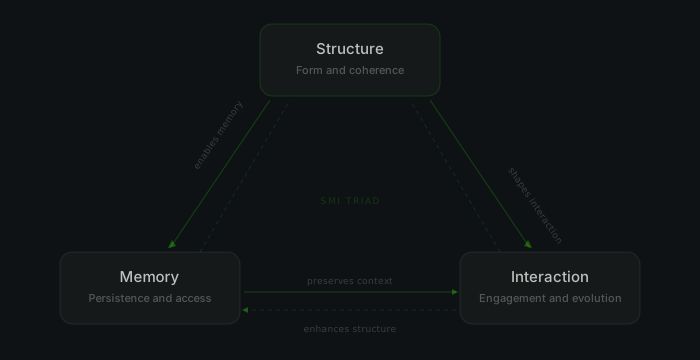
At the heart of Intelligence Engineering lies the Structure-Memory-Interaction (SMI) Triad - a framework that recognizes three essential and interdependent aspects of functioning knowledge systems:
Structure: The architectural patterns and organizing principles that give knowledge form and coherence, including:
- Taxonomies and ontologies defining relationships
- Schema and metadata standards
- Modal layers separating different aspects of knowledge representation
- Boundaries that define epistemic units
Memory: The mechanisms through which knowledge persists and remains accessible across contexts and time, including:
- Storage systems and persistence mechanisms
- Return paths enabling reliable revisitation
- Version control tracking evolution
- Canonical reference systems for stable identity
Interaction: The processes through which knowledge is engaged with, transformed, and evolved, including:
- Retrieval patterns and protocols
- Contribution and review workflows
- Synthesis and generative mechanisms
- Feedback loops for quality and relevance
The SMI Triad exists in recursive relationship, with each element both enabling and constraining the others:
- Structure enables effective memory by providing organizational frameworks
- Memory enables meaningful interaction by preserving context and history
- Interaction enhances structure through usage-driven evolution
Epistemic systems fail when these elements fall out of alignment or when one dominates at the expense of others. Traditional knowledge management approaches typically prioritize structure (organization schemes) or memory (storage systems) while neglecting interaction (transformation processes). Intelligence Engineering deliberately balances and integrates all three elements to enable recursive knowledge development.
1.2.2 Return as Intelligence
A foundational principle of Intelligence Engineering is that returning to previously encountered knowledge is not merely an act of retrieval but a generative process through which intelligence compounds. This principle, known as "Return as Intelligence," inverts conventional models that privilege novelty and initial capture over revisitation and refinement.
Where traditional systems focus on efficient capture and storage, Intelligence Engineering prioritizes effective return paths - mechanisms that enable knowledge to be revisited, recontextualized, and recursively improved. Implementation patterns that follow from this principle include:
- Designed Returnability: Knowledge structures explicitly designed to enable effective revisitation
- Contextual Reactivation: Systems that reactivate relevant knowledge at appropriate moments
- Evolution Tracking: Mechanisms that capture how knowledge transforms through recursive engagement
- Stable Addressability: Persistent identifiers that enable reliable reference across time
- Integration Scaffolding: Structures that support the integration of new and existing knowledge
By treating return as a generative rather than passive act, Intelligence Engineering creates the conditions for intelligence to compound rather than merely accumulate.
1.2.3 Dimensional Coherence
The principle of Dimensional Coherence establishes that knowledge systems function optimally when their dimensions are aligned, balanced, and integrated. These dimensions include:
- Structural-Dynamic Balance: Knowledge architecture supports rather than impedes flow
- Strategic-Operational Alignment: High-level direction translates effectively into execution
- Interface-Orchestration Coherence: Individual interactions support collective coordination
- Recursive-Evolutionary Integration: Self-improvement mechanisms enable system-level transformation
Dimensional Coherence can be measured through:
- Interdomain friction coefficients
- Alignment indices between adjacent domains
- Integration metrics across the full stack
- Coherence stability under varying conditions
This principle ensures that the various aspects of knowledge systems operate in harmony rather than opposition, creating the conditions for intelligence to develop coherently across multiple dimensions.
1.2.4 Recursive Learning
Recursive Learning establishes that knowledge systems must contain mechanisms for self-monitoring, self-correction, and self-evolution. This principle recognizes that the most powerful forms of intelligence emerge not from static structures but from systems that can reflect on and improve their own functioning.
Key aspects of Recursive Learning include:
- Performance Evaluation: Assessing the effectiveness of knowledge processes against defined metrics
- Error Detection: Identifying inconsistencies, failures, or limitations in knowledge structures and processes
- Calibration Systems: Aligning confidence with actual performance through systematic feedback
- Learning Integration: Incorporating new insights to improve future performance
- Ontological Evolution: Modifying fundamental knowledge structures based on accumulated experience
Through Recursive Learning, knowledge systems develop not just through the addition of new content but through the refinement of their own structures and processes, creating the conditions for compound rather than linear growth.
1.2.5 Evolutionary Design
The principle of Evolutionary Design establishes that long-term system viability requires architecting for evolution rather than point-optimization of current conditions. This principle recognizes that knowledge environments constantly change, requiring systems that can adapt fundamentally rather than merely optimize within fixed parameters.
Key aspects of Evolutionary Design include:
- Architectural Adaptation: Modifying fundamental structures in response to changing requirements
- Paradigm Shifts: Transitioning between qualitatively different intelligence frameworks
- Environmental Co-evolution: Adapting to and simultaneously reshaping cognitive environments
- Emergence Management: Guiding the development of new emergent properties
- Long-term Viability: Ensuring sustained relevance and effectiveness across changing contexts
Through Evolutionary Design, knowledge systems remain viable not through static perfection but through dynamic adaptation, creating the conditions for sustained relevance in changing environments.
1.3 The Unified Architecture of Intelligence Engineering
Intelligence Engineering implements a unified architecture that addresses different aspects of intelligence through scientific inquiry and engineering practice while maintaining coherence across the entire system. This architecture enables specialized focus on distinct functions while ensuring integration through explicit Science→Engineering flows and Engineering→Science feedback loops.
1.3.1 Modal Layer Architecture
The Modal Layer Architecture separates distinct aspects of knowledge representation and processing while maintaining coherence across scientific understanding and engineering implementation. The five modal layers, from foundational to emergent, are:
- Data Layer: The substrate of discrete information units, studied by science and implemented by engineering
- Logic Layer: The rules and patterns that organize information, understood through scientific principles and built through engineering systems
- Interface Layer: The boundary where agents engage with knowledge, studied for interaction patterns and designed for effective engagement
- Orchestration Layer: The coordination of multiple knowledge processes, analyzed for coordination principles and implemented as coordination systems
- Feedback Layer: The mechanisms through which knowledge systems learn and evolve, studied for learning patterns and designed for adaptive capability
Each layer builds upon those below it, creating an integrated stack that addresses the full lifecycle of knowledge through both scientific understanding and engineering implementation.
1.3.2 The Ten Fields of Intelligence Engineering
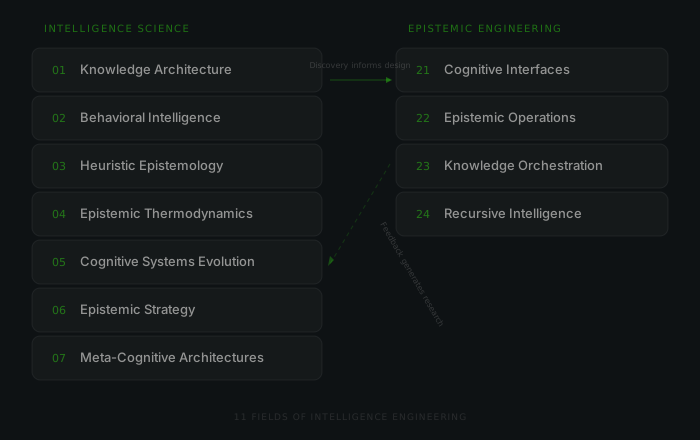
Intelligence Engineering comprises ten distinct but interconnected fields, organized into scientific disciplines that study intelligence phenomena and engineering disciplines that build intelligence systems:
Intelligence Science (7 Fields)
Intelligence Science studies the natural laws, patterns, and principles governing intelligence systems:
-
Knowledge Architecture: Studies the structural laws and principles governing how intelligence systems organize, store, and relate information. Investigates structural integrity principles, ontological consistency requirements, semantic relationship patterns, and memory organization principles that enable stable knowledge representation.
-
Behavioral Intelligence: Studies the dynamic principles governing how knowledge flows, transforms, and behaves within and between intelligence systems. Investigates energy conservation in knowledge processes, entropy accumulation patterns, flow dynamics, resonance phenomena, and momentum patterns that characterize knowledge circulation.
-
Heuristic Epistemology: Studies the patterns and principles governing cognitive shortcuts, rules of thumb, and practical reasoning strategies in intelligence systems. Investigates heuristic formation patterns, cognitive bias emergence, approximation accuracy trade-offs, fast-and-frugal reasoning principles, and reliability conditions that determine when cognitive shortcuts succeed or fail.
-
Epistemic Thermodynamics: Studies the energy and entropy laws governing knowledge creation, transformation, and decay in intelligence systems. Investigates energy conservation principles in knowledge processes, entropy tendencies in information systems, free energy principles in cognitive systems, temperature analogues in knowledge dynamics, and phase transitions in epistemic states.
-
Cognitive Systems Evolution: Studies the transformation patterns and evolutionary principles governing how intelligence systems change, adapt, and develop over time. Investigates evolutionary selection pressures on intelligence, adaptation mechanisms, emergence patterns, developmental trajectories, and co-evolution dynamics between systems.
-
Epistemic Strategy: Studies the natural patterns and principles governing how intelligence systems align with purposes, allocate attention, and maintain directional coherence. Investigates purpose alignment mechanisms, attention allocation patterns, strategic coherence principles, value integration dynamics, and goal hierarchy formation.
Epistemic Engineering (4 Fields)
Epistemic Engineering designs and builds systems that implement intelligence capabilities:
-
Cognitive Interfaces: Designs boundary interaction systems, representation frameworks, and translation mechanisms that enable intelligence systems to interact effectively with their environments and other systems. Builds multi-modal representation systems, human-AI interaction interfaces, cross-domain translation mechanisms, adaptive interface architectures, and context-aware interaction systems.
-
Epistemic Operations: Designs execution systems, operational mechanisms, and implementation frameworks that reliably transform knowledge into action while maintaining operational integrity. Builds knowledge execution engines, task orchestration systems, operational integrity monitors, process automation frameworks, and quality assurance mechanisms.
-
Recursive Intelligence: Designs self-monitoring systems, improvement mechanisms, and reflective architectures that enable intelligence systems to understand and enhance their own capabilities. Builds self-assessment frameworks, performance monitoring systems, adaptive improvement mechanisms, meta-cognitive architectures, and learning integration systems.
-
Knowledge Orchestration: Designs coordination architectures, integration frameworks, and collaboration systems that enable multiple intelligence entities to work together effectively. Builds multi-agent coordination protocols, distributed decision systems, context synchronization mechanisms, collaborative knowledge systems, and consensus formation architectures.
1.3.3 Science→Engineering Knowledge Flows
Scientific understanding in Intelligence Engineering directly informs engineering practice through specific knowledge transfer patterns:
Knowledge Architecture Science → Cognitive Interfaces Engineering:
- Structural integrity principles inform representation system design
- Semantic relationship patterns guide translation mechanism development
- Memory organization laws shape interface architecture choices
Behavioral Intelligence Science → Epistemic Operations Engineering:
- Flow dynamics inform process execution design
- Energy conservation principles guide resource allocation mechanisms
- Entropy patterns shape quality assurance systems
Heuristic Epistemology Science → Recursive Intelligence Engineering:
- Cognitive shortcut patterns inform self-assessment design
- Bias principles guide monitoring system development
- Approximation strategies shape adaptive mechanisms
Epistemic Thermodynamics Science → Knowledge Orchestration Engineering:
- Energy conservation laws inform coordination protocol design
- Entropy principles guide consensus mechanism development
- Phase transition patterns shape collaboration architectures
Cognitive Systems Evolution Science → All Engineering Fields:
- Adaptation patterns inform all system design choices
- Emergence principles guide architecture development
- Developmental constraints shape implementation strategies
Epistemic Strategy Science → All Engineering Fields:
- Purpose alignment patterns inform all design priorities
- Attention allocation principles guide resource distribution
- Strategic coherence laws shape system integration
1.3.4 Engineering→Science Feedback Loops
Engineering implementations generate new scientific insights through systematic feedback mechanisms:
Cognitive Interfaces Engineering → Knowledge Architecture Science:
- Implementation challenges reveal new structural requirements
- Representation failures identify architectural limitations
- Translation breakdowns suggest new semantic principles
Epistemic Operations Engineering → Behavioral Intelligence Science:
- Execution bottlenecks reveal flow pattern insights
- Resource allocation failures suggest new energy principles
- Quality degradation patterns indicate entropy dynamics
Recursive Intelligence Engineering → Heuristic Epistemology Science:
- Self-assessment failures reveal cognitive pattern insights
- Improvement mechanisms suggest new heuristic principles
- Learning patterns indicate reasoning strategy effectiveness
Knowledge Orchestration Engineering → Epistemic Thermodynamics Science:
- Coordination failures reveal energy distribution insights
- Consensus difficulties suggest entropy management principles
- Collaboration patterns indicate phase transition dynamics
All Engineering Fields → Cognitive Systems Evolution Science:
- System failures reveal adaptation constraints
- Implementation successes suggest emergence patterns
- Architectural choices influence evolutionary trajectories
All Engineering Fields → Epistemic Strategy Science:
- Misalignment patterns reveal purpose dynamics
- Resource conflicts suggest attention allocation principles
- Integration failures indicate strategic coherence requirements
1.3.5 The Threshold of Epistemic Escape Velocity
A critical concept in Intelligence Engineering is the Threshold of Epistemic Escape Velocity - the point at which a knowledge system begins to generate more capability than it consumes. This threshold represents the transition from systems that require constant maintenance to preserve meaning to systems that compound understanding through their own operation.
The threshold emerges from the integration of scientific understanding and engineering implementation, where scientific principles guide the design of systems that can cross the threshold, and engineering feedback validates and refines the theoretical understanding of what makes threshold crossing possible.
2. The Epistemic Engine: Structuring Intelligence for Compounding Growth
2.1 Concept of Cognitive Infrastructure
The Epistemic Engine establishes a new paradigm that treats knowledge not as content to be stored but as infrastructure to be engineered. This shift from repository to engine represents a fundamental reconceptualization of knowledge systems:
| Aspect | Knowledge Repository | Epistemic Engine |
|---|---|---|
| Core Purpose | To store, organize, and retrieve knowledge | To evolve, transform, and generate insight |
| Primary Metaphor | A library or database | A mind or cognitive processor |
| Temporal Behavior | Static, archival | Dynamic, recursive |
| Structure | Tags, folders, documents | Inputs, feedback loops, synthesis flows |
| Relationship to Time | Preserves snapshots | Enables iteration and growth |
| Data Types | Articles, summaries, notes | Tensions, questions, partials, patterns |
| User Role | Archivist or curator | Co-thinker, sensemaker, modeler |
| AI Relationship | Enhances retrieval | Co-generates meaning |
| Flow | Linear accumulation | Circular recursion |
| End State | Well-structured knowledge | Evolving intelligence infrastructure |
This paradigm shift addresses the fundamental limitations of traditional knowledge systems by creating the cognitive infrastructure through which intelligence can flow, transform, and evolve while maintaining semantic integrity. The Epistemic Engine doesn't just store knowledge but actively participates in its development through cycles of structured engagement.
The concept of cognitive infrastructure extends beyond mere technical systems to encompass the full spectrum of architectural patterns, operational processes, and evolutionary mechanisms that enable intelligence to compound across contexts. This infrastructure creates the conditions for knowledge to maintain meaning while continuously evolving through deliberate design.
2.2 Context Modules, Knowledge Composition, Recursive Refinement, Knowledge Evolution Maps
The Epistemic Engine implements four core architectural patterns that together enable intelligence to maintain semantic integrity while evolving recursively.
2.2.1 Context Modules: Knowledge That Remembers Its Meaning
Context Modules address the problem of semantic dissolution - the tendency for knowledge to lose meaning as it moves across contexts and time. Traditional knowledge units (notes, documents, articles) capture information but lose the context that gave it meaning, like pressed flowers that preserve appearance but lose the living essence.
Context Modules solve this problem by packaging ideas with their essential context:
- Boundaries: Where the knowledge applies and doesn't apply
- Assumptions: The foundation upon which the knowledge builds
- Relationships: How the knowledge connects to other concepts
- Purpose: Why the knowledge matters and how it's meant to be used
This contextual encapsulation creates knowledge that maintains its meaning across time, tools, and minds. When you build with Context Modules, you create knowledge that doesn't need you to remember what made it meaningful - it carries that meaning within its architecture.
The dual-format implementation of Context Modules - with human-readable (markdown) and machine-actionable (JSON) representations - ensures that semantic integrity is maintained across both human and computational interactions.
2.2.2 Knowledge Composition: Ideas That Build Upon Each Other
Knowledge Composition addresses the challenge of integration failure - the difficulty of systematically combining insights across domains to generate new understanding. While some of our most valuable insights come from combining ideas from different domains, these combinations often happen by accident rather than design.
Knowledge Composition provides a structured approach for deliberately combining well-formed modules to generate new insights:
- Boundary Analysis: Understanding where and how different knowledge domains intersect
- Assumption Integration: Reconciling different foundational premises
- Relationship Mapping: Creating explicit connections between concepts
- Purpose Alignment: Ensuring composed knowledge serves coherent objectives
This deliberate composition creates new understanding that transcends the original components while maintaining intellectual integrity. Rather than random association, it involves architectural choices about how ideas can connect in meaningful ways.
The Epistemic Engine implements Knowledge Composition through relationship-aware embedding, composition operations, and explicit mapping of connections between knowledge components. These mechanisms create the conditions for knowledge to build upon itself systematically rather than fragmenting across boundaries.
2.2.3 Recursive Refinement: Learning That Compounds
Recursive Refinement addresses the recursion breakdown in traditional systems - the tendency for knowledge to accumulate linearly rather than compound through cycles of engagement. While our most powerful learning happens when insights evolve through application and reflection, most systems focus on accumulation rather than evolution.
Recursive Refinement creates deliberate feedback loops where knowledge improves through use:
- Application: Putting knowledge into practice in specific contexts
- Observation: Gathering data about effectiveness and limitations
- Reflection: Analyzing patterns and identifying improvement opportunities
- Evolution: Transforming the knowledge based on accumulated insights
Each cycle doesn't just add to understanding but transforms it, creating compound growth rather than simple accumulation. This is the difference between a static building and a home that evolves to better serve its inhabitants over time.
The Epistemic Engine implements Recursive Refinement through the Recursive Augmented Retrieval Architecture (RARA) - a framework that transforms traditional retrieval into a rich cognitive infrastructure supporting knowledge evolution. RARA enables knowledge to develop through structured engagement rather than merely accumulating through collection.
2.2.4 Knowledge Evolution Maps: Understanding That Connects
Knowledge Evolution Maps address the challenge of orchestrating knowledge development across complex systems. Isolated insights, no matter how profound, can't address challenges that span multiple domains and evolve over time.
Knowledge Evolution Maps create structured pathways for knowledge to evolve systematically:
- Current State Mapping: Documenting existing knowledge structures and relationships
- Developmental Tension Identification: Recognizing areas requiring evolution
- Growth Vector Definition: Establishing directions for knowledge development
- Evolutionary Milestone Sequencing: Creating staged pathways for knowledge transformation
These maps enable coordination of knowledge development across distributed systems, ensuring that evolution follows coherent patterns rather than fragmenting across boundaries. They represent not just what is known but how knowledge should develop to address emerging challenges.
The Epistemic Engine implements Knowledge Evolution Maps through system-level orchestration of recursive knowledge development, creating the conditions for distributed intelligence to evolve coherently despite operating across different contexts and agents.
2.3 From Static Knowledge to Living Systems
The Epistemic Engine transforms knowledge management from static preservation to living evolution through several key mechanisms:
2.3.1 Dual-Format Knowledge Components
Every knowledge component exists in two complementary formats:
- Human-Readable Format (.md):
- Markdown files optimized for human readability
- Consistent YAML front matter with metadata
- Clear semantic structure with standard sections
- Rich linking to related components
- Machine-Actionable Format (.json):
- JSON representation of the same content
- Structured metadata for algorithmic processing
- Explicit typing and relationship information
- Semantic classification for machine reasoning
This dual-format approach ensures that knowledge components are simultaneously:
- Human-readable for direct engagement
- Machine-actionable for algorithmic processing
- Semantically rich for meaningful relationships
- Structurally consistent for system integrity
2.3.2 Canonical Publishing Workflow
The Epistemic Engine implements a structured publishing workflow that maintains knowledge integrity throughout the contribution and evolution process:
- Draft Creation
- Initial component creation with minimal required metadata
- Assignment of draft ID and version (0.x.y)
- Placement in
/pending/directory - Generation of both
.mdand.jsonrepresentations - Initial relationship suggestions
- Review Process
- Automated validation against schema requirements
- Duplicate/overlap detection against existing components
- Expert review for accuracy, clarity, and coherence
- Relationship verification and enrichment
- Version incrementing based on feedback iterations
- Canonicalization
- Approval by knowledge steward/domain expert
- Assignment of
canonicalstatus and version 1.0.0 - Moving from
/pending/to canonical location - Update of
canonical_datetimestamp - Knowledge graph integration and index refresh
- Evolution
- Ongoing version increments following semantic versioning:
- PATCH (1.0.x): Clarifications, corrections, minor improvements
- MINOR (1.x.0): Additions that preserve backward compatibility
- MAJOR (x.0.0): Significant changes that may affect dependents
- Explicit version history tracking
- Relationship updates as component evolves
- Continuous validation of integrity and coherence
- Ongoing version increments following semantic versioning:
- Deprecation (when necessary)
- Change of status to "deprecated"
- Documentation of deprecation rationale
- Reference to replacement components if applicable
- Maintenance of deprecated version for historical reference
- Knowledge graph updates to reflect deprecation
This structured workflow ensures that knowledge components maintain integrity throughout their lifecycle while enabling continuous evolution.
2.3.3 Epistemic Types and Knowledge Components
The Epistemic Engine rejects the common practice of treating all knowledge as undifferentiated "content." Instead, it recognizes distinct epistemic types - different kinds of knowledge components that serve specific functions within the overall architecture.
Core epistemic types include:
- Core Concepts: Foundational ideas that define essential elements of a domain
- Patterns: Reusable solutions to recurring problems
- Anti-Patterns: Common mistakes and their remedies
- Frameworks: Structural systems for organizing understanding
- Diagnostics: Methods for identifying issues and evaluating states
- Principles: Fundamental rules that guide decision-making
- Laws: Consistent relationships between elements
- Case Studies: Contextual examples of concepts in action
- Essays: Explorations that develop understanding of complex topics
Each type has its own schema, relationships, and usage patterns. This typological approach offers several advantages:
- Knowledge components maintain their appropriate structure and function
- Different types can be processed and presented in context-appropriate ways
- Relationships between components can reflect semantic meaning (implements, contradicts, exemplifies)
- Search and retrieval can consider type-specific needs
By preserving epistemic types throughout the knowledge lifecycle, the Epistemic Engine maintains the integrity of different knowledge functions, enabling more sophisticated intelligence development.
2.3.4 Cognitive Infrastructure Retrieval (CIR)
Traditional retrieval-augmented generation (RAG) systems typically chunk documents into arbitrary text windows and embed them for similarity search. This approach fundamentally misaligns with how knowledge actually functions, treating all information as undifferentiated content and losing critical context.
The Epistemic Engine implements Cognitive Infrastructure Retrieval (CIR) - a structured, recursive, and epistemically-aware retrieval architecture designed to maintain knowledge integrity throughout the retrieval process:
Core Principles of CIR:
- Epistemic Integrity: Knowledge components maintain clear boundaries and identities
- Components chunked by semantic boundaries, not arbitrary token counts
- Explicit type preservation in embeddings and retrieval
- Provenance tracking maintains awareness of knowledge origins
- Versioning preserved throughout retrieval process
- Structural Coherence: Relationships between components guide retrieval
- Explicit relationship types inform retrieval relevance
- Navigation follows semantic pathways, not just similarity
- Composition respects component boundaries and interfaces
- Hierarchies enable zooming between details and broader context
- Recursive Engagement: Retrieval builds upon previous interactions
- Knowledge retrieval tracks how components are used
- Return pathways enable reliable revisitation
- Feedback loops integrate usage patterns
- Cross-reference mechanisms maintain consistency
- Collaborative Intelligence: The system supports multiple agents
- Different agents can operate on shared knowledge
- Structural understanding enables coordination
- Role-specific views adapt to different needs
- Consistent interfaces enable knowledge transfer
This approach transforms retrieval from a simple lookup operation into a rich cognitive infrastructure that supports recursive knowledge development. Unlike traditional RAG, CIR doesn't merely retrieve content for immediate use; it creates the conditions for knowledge to evolve through structured engagement.
2.4 Multi-Agent Orchestration Protocols
The Epistemic Engine is designed to support collaborative knowledge development across multiple agents - both human and artificial. This multi-agent ecosystem requires specific protocols to maintain coherence while enabling diverse contributions.
2.4.1 Agent Types and Roles
The Epistemic Engine supports diverse agent types with specific roles:
- Knowledge Authors: Create original content and insights
- Knowledge Stewards: Maintain quality and coherence
- Knowledge Explorers: Discover connections and implications
- Knowledge Implementers: Apply insights to specific contexts
- Knowledge Synthesizers: Integrate across domains and sources
- Knowledge Validators: Verify accuracy and applicability
2.4.2 Coordination Mechanisms
Effective multi-agent knowledge work requires clear coordination protocols that maintain coherence without restricting contribution diversity:
- Shared Context Establishment:
- Common grounding in domain fundamentals
- Explicit alignment on terminology and concepts
- Shared understanding of project scope and goals
- Transparent access to relevant knowledge components
- Role-Based Access and Contribution:
- Clear delineation of agent responsibilities
- Appropriate permissions based on expertise and role
- Contribution workflows matched to agent capabilities
- Accountability mechanisms for quality control
- Work Distribution Frameworks:
- Task decomposition into appropriate units
- Capability-appropriate assignments
- Dependency management across tasks
- Progress tracking and bottleneck identification
- Conflict Resolution Process:
- Explicit mechanisms for addressing disagreements
- Evidence standards for competing claims
- Escalation pathways for unresolved conflicts
- Versioning to maintain alternative perspectives
- Integration Protocols:
- Clear procedures for merging contributions
- Quality standards for acceptance
- Attribution preservation for contributors
- Relationship maintenance during integration
2.4.3 Human-AI Collaboration Patterns
Human-AI collaboration requires specific attention to the unique capabilities and limitations of different agent types:
- Complementary Capability Allocation:
- AI for pattern recognition, consistency checking, and relationship mapping
- Humans for novel insights, quality judgment, and contextual interpretation
- Explicit recognition of comparative advantages
- Appropriate task assignment based on capability profiles
- Progressive Collaboration Workflows:
- Initial drafting by either human or AI
- Cyclical refinement with alternating contributions
- Explicit review points for quality assessment
- Iterative improvement through feedback loops
- Contextual Knowledge Transfer:
- Mechanisms for sharing relevant context
- Translation between different representational formats
- Explicit clarification of ambiguities
- Context preservation during handoffs
- Collaborative Decision Frameworks:
- Clear criteria for different decision types
- Appropriate authority allocation based on decision nature
- Transparent rationale documentation
- Feedback mechanisms for decision quality
- Learning Integration:
- Capture of successful collaboration patterns
- Analysis of friction points and failures
- Continuous improvement of collaboration protocols
- Evolution of collaboration capabilities through practice
These coordination protocols and collaboration patterns create the conditions for effective multi-agent knowledge work, enabling diverse contributions while maintaining overall coherence.
3. The Contextual Intelligence Operating System (CI-OS): Operationalizing Knowledge Evolution
3.1 Core Primitives: Contextual Encapsulation, Compositional Synthesis, Recursive Refinement, Networked Evolution
The Contextual Intelligence Operating System (CI-OS) transforms epistemic theory into operational reality through four core primitives that govern how knowledge processes function across the system.
3.1.1 Contextual Encapsulation
Contextual Encapsulation is the operational primitive that enables knowledge to maintain meaning across boundaries. It implements the architectural concept of Context Modules through procedural mechanisms that actively preserve semantic integrity during knowledge processing.
Key operational mechanisms include:
- Boundary Detection: Algorithmic identification of conceptual boundaries
- Context Preservation: Active maintenance of contextual elements during knowledge transfer
- Semantic Integrity Checking: Validation that meaning remains intact across transformations
- Identity Maintenance: Persistent identification despite representation changes
Contextual Encapsulation operates across all modal layers, ensuring that knowledge maintains coherence not just in storage but throughout active processing. Unlike traditional information encapsulation that merely packages data, Contextual Encapsulation actively preserves the full semantic dimensions that give knowledge its meaning.
3.1.2 Compositional Synthesis
Compositional Synthesis is the operational primitive that enables knowledge to combine systematically across domains. It implements the architectural concept of Knowledge Composition through procedural mechanisms that orchestrate meaningful integration without semantic loss.
Key operational mechanisms include:
- Interface Matching: Identification of compatible knowledge boundaries
- Adaptation Transformations: Modifications that enable knowledge to integrate across contexts
- Coherence Validation: Verification that composed knowledge maintains logical consistency
- Emergent Property Detection: Identification of new properties that emerge from composition
Compositional Synthesis establishes operational protocols for how knowledge components interact when combined, ensuring that integration produces meaningful synthesis rather than mere aggregation. These protocols enable knowledge from different domains to connect systematically rather than accidentally, creating pathways for cross-domain innovation.
3.1.3 Recursive Refinement
Recursive Refinement is the operational primitive that enables knowledge to improve through cycles of use. It implements the architectural concept of Refinement Cycles through procedural mechanisms that capture insights from application and incorporate them into knowledge evolution.
Key operational mechanisms include:
- Usage Pattern Analysis: Tracking how knowledge is applied across contexts
- Effectiveness Evaluation: Assessment of knowledge utility in specific applications
- Improvement Identification: Recognition of enhancement opportunities
- Version Management: Systematic evolution of knowledge components
Recursive Refinement establishes operational protocols for how knowledge improves through use, creating the feedback loops necessary for compound growth. These protocols transform knowledge application from consumption to contribution, where each use generates insights that enhance the knowledge for future applications.
3.1.4 Networked Evolution
Networked Evolution is the operational primitive that enables knowledge ecosystems to develop coherently across distributed components. It implements the architectural concept of Knowledge Networks through procedural mechanisms that orchestrate system-level transformation.
Key operational mechanisms include:
- Relationship Management: Maintenance of explicit connections between knowledge components
- Propagation Rules: Protocols for how changes spread across the network
- Coherence Maintenance: Preservation of system-level consistency during evolution
- Emergence Facilitation: Support for new systemic capabilities to develop
Networked Evolution establishes operational protocols for how knowledge evolves as a system rather than as isolated components. These protocols enable coordinated transformation across distributed knowledge ecosystems, creating the conditions for emergent intelligence that transcends individual components.
3.2 Why an Epistemic Operating System is Essential
While the Epistemic Engine provides the architectural patterns for knowledge evolution, the Contextual Intelligence Operating System (CI-OS) is essential for translating these patterns into operational reality. Several factors make this operating system layer necessary:
3.2.1 Bridging Theory and Practice
Architectural patterns alone cannot ensure effective knowledge evolution. Without operational mechanisms to implement these patterns, they remain theoretical ideals rather than practical realities. CI-OS provides the procedural substrate that transforms architectural concepts into executable processes, bridging the gap between epistemic theory and operational practice.
3.2.2 Process Consistency Across Implementations
Different technical implementations of epistemic architecture require consistent operational semantics to maintain interoperability. CI-OS creates a standard operational layer that ensures knowledge processes function consistently regardless of underlying technical infrastructure, enabling knowledge to flow across diverse implementations without semantic loss.
3.2.3 Multi-Agent Coordination
Effective knowledge evolution requires coordination across multiple agents with different capabilities and contexts. CI-OS provides the operational protocols necessary for diverse agents to collaborate effectively on knowledge development, ensuring that contributions from different sources integrate coherently rather than creating fragmentation. These coordination mechanisms enable human-AI collaboration, cross-team integration, and distributed knowledge work.
3.2.4 Runtime Adaptation
Knowledge systems operate in dynamic environments where requirements and contexts constantly change. CI-OS enables runtime adaptation of knowledge processes based on operational feedback, creating the conditions for systems to evolve their behavior without requiring architectural redesign. This adaptive capability is essential for knowledge systems to remain relevant in changing circumstances.
3.2.5 Operational Integrity
Without consistent operational semantics, even well-designed knowledge systems tend to degrade over time as implementations drift from architectural intent. CI-OS maintains operational integrity by providing explicit process definitions, validation mechanisms, and conformance checks that ensure implementations remain aligned with architectural principles. This integrity preservation is essential for long-term system viability.
3.3 How CI-OS Transforms Theoretical Structures into Recursive Operational Reality
The transformation from theoretical knowledge structures to living operational systems requires specific mechanisms that CI-OS provides:
3.3.1 Process Formalization
CI-OS formalizes the processes through which knowledge evolves, converting conceptual frameworks into executable workflows. This formalization includes:
- Process Definition Language: A formal specification of knowledge processes
- Execution Semantics: Clear operational behavior for each process
- State Transition Rules: Explicit conditions for process advancement
- Exception Handling: Mechanisms for addressing unexpected conditions
Through process formalization, CI-OS ensures that knowledge evolution follows consistent patterns rather than ad hoc procedures, creating the conditions for reliable operational behavior.
3.3.2 Context-Aware Execution
CI-OS implements context-aware execution mechanisms that maintain semantic integrity during knowledge operations. This context-awareness includes:
- Contextual Parameter Preservation: Maintenance of essential contextual elements
- Semantic Boundary Respect: Operations that honor conceptual boundaries
- Relevance Filtering: Selective processing based on contextual applicability
- Adaptation Logic: Contextual transformation during cross-domain operations
Through context-aware execution, CI-OS ensures that knowledge operations respect the semantic dimensions of the content they process, preventing the context loss that plagues traditional systems.
3.3.3 Feedback Integration
CI-OS implements feedback integration mechanisms that enable systems to learn from operational experience. This integration includes:
- Usage Telemetry: Capture of interaction patterns and operational metrics
- Effectiveness Analysis: Evaluation of knowledge utility across contexts
- Improvement Identification: Recognition of enhancement opportunities
- Learning Incorporation: Integration of insights into system behavior
Through feedback integration, CI-OS creates the recursive loops necessary for systems to improve through use rather than remaining static despite experience.
3.3.4 Distributed Coherence
CI-OS implements distributed coherence mechanisms that enable knowledge to maintain integrity across system boundaries. This coherence includes:
- Consistency Protocols: Rules for maintaining aligned state across subsystems
- Propagation Logic: Mechanisms for distributing relevant changes
- Conflict Resolution: Processes for reconciling competing updates
- Global Constraints: System-wide invariants that all subsystems must respect
Through distributed coherence, CI-OS enables knowledge to function as a unified system despite operating across distributed components, creating the conditions for system-level intelligence.
3.4 CI-OS Runtime Architecture
The Contextual Intelligence Operating System implements a runtime architecture that operationalizes epistemic principles across four layers:
3.4.1 Core Execution Layer
The Core Execution Layer handles the fundamental operations that process knowledge components:
- Component Management: Creation, retrieval, updating, and deprecation of knowledge units
- Relationship Processing: Establishment, maintenance, and navigation of knowledge connections
- Version Control: Management of knowledge evolution across time
- Identity Preservation: Maintenance of persistent identity despite representation changes
This layer provides the foundational runtime capabilities upon which higher-level knowledge operations are built.
3.4.2 Process Orchestration Layer
The Process Orchestration Layer coordinates complex knowledge workflows across components:
- Workflow Management: Sequencing and coordination of multi-step knowledge processes
- State Tracking: Maintenance of process state across operations
- Dependency Handling: Management of process interdependencies
- Exception Management: Graceful handling of unexpected conditions
This layer enables complex knowledge processes to execute reliably across distributed systems and extended timeframes.
3.4.3 Agent Coordination Layer
The Agent Coordination Layer manages interaction between diverse agents participating in knowledge processes:
- Role Management: Assignment and tracking of agent responsibilities
- Capability Matching: Alignment of tasks with agent capabilities
- Communication Protocols: Structured interaction between agents
- Consensus Mechanisms: Processes for reaching agreement on contentious issues
This layer enables effective collaboration between human and artificial agents with diverse capabilities and contexts.
3.4.4 Adaptation Layer
The Adaptation Layer enables the system to evolve its behavior based on experience:
- Performance Monitoring: Tracking of operational effectiveness
- Pattern Recognition: Identification of recurring issues and opportunities
- Rule Evolution: Modification of system behavior based on accumulated insights
- Learning Integration: Incorporation of insights into operational patterns
This layer creates the conditions for knowledge systems to improve through experience rather than remaining static despite changing circumstances.
3.5 Integration with the Epistemic Engine
CI-OS integrates with the Epistemic Engine through specific operational mechanisms that implement architectural patterns:
3.5.1 Dual-Format Synchronization
CI-OS maintains synchronization between human-readable and machine-actionable representations of knowledge components. This synchronization ensures that changes in either format propagate appropriately to the other, maintaining representational consistency without requiring manual updates.
3.5.2 Process-Architecture Alignment
CI-OS implements operational processes that align with the architectural patterns defined by the Epistemic Engine. This alignment ensures that runtime behavior implements architectural intent, preventing the operational drift that often occurs between design and implementation.
3.5.3 Feedback Flow
CI-OS establishes feedback flows that connect operational experience with architectural evolution. These flows ensure that insights gained through system operation inform architectural refinement, creating the conditions for the Epistemic Engine itself to evolve based on operational reality.
3.5.4 Multi-Layer Operation
CI-OS operates across all layers of the Modal Architecture, with different operational mechanisms appropriate to each layer:
- Data Layer Operations: Component-level CRUD operations with integrity preservation
- Logic Layer Operations: Relationship management and consistency maintenance
- Interface Layer Operations: Context-aware presentation and interaction handling
- Orchestration Layer Operations: Process coordination and workflow management
- Feedback Layer Operations: Learning integration and evolution facilitation
This multi-layer operation ensures that CI-OS provides appropriate runtime support for all aspects of the Epistemic Engine.
4. Composable Epistemic Microservices: The Computational Substrate of Living Knowledge
4.1 Definition and Properties of Epistemic Microservices
Composable Epistemic Microservices represent the computational instantiation of the theoretical and operational frameworks of Intelligence Engineering. They transform abstract architectural patterns and operational processes into concrete, executable components that form the living computational substrate of knowledge systems.
4.1.1 Fundamental Definition
An Epistemic Microservice is a self-contained, focused computational unit that implements a specific epistemic function while maintaining clear semantic boundaries and explicit relationships with other services. Unlike traditional microservices that primarily address technical concerns, Epistemic Microservices are designed to embody epistemological principles in their computational implementation.
4.1.2 Core Properties
Epistemic Microservices exhibit several essential properties that distinguish them from conventional computational services:
- Semantic Boundedness: Each service has clearly defined epistemic boundaries that delineate its domain of responsibility
- Contextual Awareness: Services maintain awareness of the semantic context in which they operate
- Explicit Relationships: Services declare formal relationships with other services that reflect epistemic dependencies
- Recursive Capability: Services can apply their functions to their own structures, enabling self-improvement
- Evolvability: Services are designed to evolve their behavior based on operational feedback
- Composability: Services can be combined to create more complex epistemic functions without losing semantic integrity
These properties create the foundation for computational systems that embody the principles of Intelligence Engineering rather than merely implementing technical functionality.
4.1.3 Typology of Epistemic Microservices
Epistemic Microservices exist in several fundamental types, each addressing different aspects of knowledge processing:
- Structural Services: Maintain the architectural integrity of knowledge components
- Component Manager: Handles the lifecycle of knowledge components
- Relationship Engine: Manages connections between components
- Schema Validator: Ensures structural conformance to epistemic types
- Boundary Guardian: Maintains clear epistemic boundaries
- Dynamic Services: Govern the flow and transformation of knowledge
- Composition Engine: Facilitates meaningful integration across components
- Transformation Processor: Handles knowledge representation changes
- Flow Regulator: Manages knowledge circulation patterns
- Energy Monitor: Tracks epistemic energy across the system
- Operational Services: Execute knowledge-based processes
- Query Resolver: Processes knowledge queries with context preservation
- Action Executor: Implements knowledge-based actions
- Decision Engine: Facilitates knowledge-informed decision processes
- Process Orchestrator: Coordinates complex knowledge workflows
- Recursive Services: Enable system self-awareness and improvement
- Performance Analyzer: Evaluates system effectiveness
- Pattern Recognizer: Identifies recurring operational patterns
- Learning Integrator: Incorporates insights into system behavior
- Calibration Manager: Maintains alignment between confidence and performance
- Evolutionary Services: Support system-level adaptation and growth
- Adaptation Engine: Modifies service behavior based on experience
- Emergence Detector: Identifies new systemic capabilities
- Version Manager: Handles transition between system states
- Coherence Guardian: Maintains system integrity during evolution
This typology creates a comprehensive set of computational components that together implement the full spectrum of epistemic functions required for living knowledge systems.
4.2 The Architecture of Living Computational Knowledge
Epistemic Microservices are organized into a coherent architecture that enables them to function as a unified system while maintaining the benefits of modularity and specialization.
4.2.1 Architectural Layers
The architecture of Epistemic Microservices follows the Modal Layer Architecture of the Epistemic Engine, with specific computational implementations at each layer:
- Data Layer Implementation:
- Component storage and retrieval systems
- Metadata indexing mechanisms
- Identifier resolution services
- Format transformation processors
- Logic Layer Implementation:
- Relationship database with graph capabilities
- Semantic typing services
- Consistency validation engines
- Status management systems
- Interface Layer Implementation:
- Presentation adaptation services
- Context-aware rendering engines
- Navigation path generators
- Interaction processing systems
- Orchestration Layer Implementation:
- Workflow engines for knowledge processes
- Integration frameworks for cross-system connections
- Coordination services for multi-agent activities
- Governance enforcement mechanisms
- Feedback Layer Implementation:
- Usage analytics processors
- Learning integration services
- Version control systems
- Attribution tracking mechanisms
This layered implementation ensures that Epistemic Microservices maintain architectural coherence while addressing specific computational concerns at each level.
4.2.2 Inter-Service Communication
Epistemic Microservices communicate through semantically rich protocols that preserve epistemic context during interaction:
- Context-Carrying Messages: Communication includes essential contextual elements
- Semantic Contracts: Explicit declarations of expected meaning preservation
- Relationship-Aware Routing: Message pathways reflect epistemic relationships
- Type-Specific Handling: Processing adapted to epistemic type of content
These communication patterns ensure that the distributed nature of microservices doesn't lead to semantic fragmentation, maintaining knowledge integrity across service boundaries.
4.2.3 Compositional Patterns
Epistemic Microservices compose into higher-order capabilities through specific patterns that maintain semantic integrity:
- Semantic Composition: Services combine based on meaningful relationships
- Contextual Binding: Composition preserves essential context
- Recursive Nesting: Services can contain other services while maintaining boundaries
- Emergent Capability Formation: Composed services develop capabilities beyond component functions
These compositional patterns enable complex epistemic functions to emerge from simpler components without losing coherence, creating the conditions for scalable knowledge capabilities.
4.3 How Modular, Localized, Recursive, Evolvable Microservices Instantiate Epistemic Structures
Epistemic Microservices implement the theoretical frameworks of Intelligence Engineering through specific architectural properties that align computational implementation with epistemic principles.
4.3.1 Modularity Implementation
The modularity of Epistemic Microservices implements key epistemological principles:
- Bounded Context Realization: Services embody the concept of bounded contexts, maintaining clear semantic boundaries
- Cognitive Load Management: Focused services reduce complexity to manageable units
- Specialized Expertise: Services develop depth in specific epistemic functions
- Independent Evolution: Services can evolve at different rates based on different pressures
This modularity enables knowledge systems to maintain clarity and coherence despite growing complexity, as each service handles a focused aspect of the overall epistemic function.
4.3.2 Localization Implementation
The localization of Epistemic Microservices implements key epistemological principles:
- Context Preservation: Local processing maintains essential contextual elements
- Boundary Integrity: Clear service boundaries prevent semantic leakage
- Responsibility Clarity: Explicit local responsibility for specific functions
- Failure Containment: Localized issues remain contained rather than contaminating the system
This localization enables knowledge systems to maintain semantic integrity despite distributed processing, as each service takes responsibility for preserving meaning within its domain.
4.3.3 Recursion Implementation
The recursive nature of Epistemic Microservices implements key epistemological principles:
- Self-Applicable Functions: Services can apply their capabilities to themselves
- Hierarchical Nesting: Services can contain instances of the same pattern at different scales
- Reflective Capability: Services can reason about their own behavior
- Improvement Cycles: Services can enhance their own functioning through feedback
This recursion enables knowledge systems to improve through self-reference, as services apply their intelligence to their own evolution rather than requiring external intervention.
4.3.4 Evolution Implementation
The evolvability of Epistemic Microservices implements key epistemological principles:
- Adaptive Behavior: Services modify their function based on experience
- Version Transitions: Services manage their own evolutionary progression
- Capability Development: Services extend their functionality over time
- Environmental Response: Services adapt to changing operational contexts
This evolvability enables knowledge systems to remain relevant in changing environments, as services continuously adapt their behavior based on operational feedback rather than remaining static.
4.4 Implementation Patterns and Technical Architecture
The implementation of Epistemic Microservices follows specific technical patterns that instantiate epistemic principles while ensuring practical deployability and performance.
4.4.1 Service Implementation Architecture
Each Epistemic Microservice implements a consistent internal architecture:
- Epistemic Core: Implements the fundamental epistemic function
- Context Manager: Maintains awareness of operational context
- Interface Layer: Defines interaction with other services
- Reflection Engine: Enables service to reason about its own behavior
- Evolution Manager: Handles service adaptation over time
This consistent architecture ensures that all services maintain essential epistemic capabilities regardless of their specific function, creating a foundation for system-wide epistemic coherence.
4.4.2 Technical Stack
Epistemic Microservices can be implemented across various technical stacks, with some common patterns:
- Event-Driven Architecture: Services communicate through semantically rich events
- Graph Database Integration: Services leverage graph structures for relationship representation
- Vector Space Capabilities: Services utilize embedding spaces for semantic similarity
- Machine Learning Components: Services incorporate learning capabilities for adaptation
- Distributed Ledger Options: Services may use distributed ledgers for provenance tracking
This flexible technical approach enables Epistemic Microservices to leverage appropriate technologies while maintaining consistent epistemic principles across implementations.
4.4.3 Deployment Models
Epistemic Microservices support multiple deployment models based on system requirements:
- Cloud-Native Deployment: Distributed services across cloud infrastructure
- Edge Computing Integration: Services operating at network edges for context specificity
- Hybrid Human-AI Systems: Services specifically designed for human-AI collaboration
- Embedded Epistemic Systems: Services operating within constrained environments
This deployment flexibility enables Epistemic Microservices to adapt to diverse operational contexts while maintaining consistent epistemic behavior.
4.4.4 Implementation Lifecycle
The development and evolution of Epistemic Microservices follows a lifecycle that embeds epistemic principles in the implementation process:
- Epistemic Function Definition: Clear articulation of the service's knowledge function
- Boundary Specification: Explicit definition of semantic boundaries
- Relationship Mapping: Identification of connections to other services
- Implementation with Reflection: Development that includes reflective capabilities
- Deployment with Telemetry: Operation that captures performance data
- Evolution Through Feedback: Adaptation based on operational experience
This lifecycle ensures that services remain aligned with epistemic principles throughout their existence, from initial conception through ongoing evolution.
5. The Unified System: From Conceptual Foundations to Living Computational Ecosystems
5.1 How the Epistemic Engine, CI-OS, and Composable Epistemic Microservices Interlock
The three primary components of the Architecture of Living Intelligence - the Epistemic Engine, the Contextual Intelligence Operating System, and Composable Epistemic Microservices - form an integrated system where each layer enables and constrains the others, creating a coherent whole that spans from conceptual foundations to computational implementation.
5.1.1 Architectural Relations
The relationships between these components follow a layered pattern with bidirectional influence:
- Conceptual-Operational Relationship: The Epistemic Engine provides architectural patterns that CI-OS implements as operational processes. Simultaneously, operational insights from CI-OS inform architectural refinement in the Epistemic Engine.
- Operational-Computational Relationship: CI-OS defines operational semantics that Epistemic Microservices implement as computational units. Simultaneously, implementation experience from Microservices informs operational refinement in CI-OS.
- Computational-Conceptual Relationship: Epistemic Microservices provide computational instantiation of the architectural patterns defined by the Epistemic Engine. Simultaneously, computational capabilities and constraints influence architectural possibilities in the Epistemic Engine.
This circular relationship creates a coherent system where theory informs practice and practice refines theory, enabling continuous co-evolution of all components.
5.1.2 Integration Mechanisms
Specific mechanisms enable integration across these components:
- Semantic Contract Propagation: Architectural contracts defined by the Epistemic Engine propagate through operational specifications in CI-OS to implementation requirements in Epistemic Microservices.
- Telemetry Feedback Loops: Operational data from Epistemic Microservices flows through analysis in CI-OS to inform architectural refinement in the Epistemic Engine.
- Cross-Layer Identity Preservation: Knowledge components maintain consistent identity across architectural representation, operational processing, and computational implementation.
- Coherence Validation Chains: Consistency checks at each layer verify alignment with adjacent layers, ensuring that implementation correctly reflects architecture.
These mechanisms ensure that the system maintains coherence across its full depth, from conceptual foundations to computational execution.
5.1.3 Evolution Synchronization
The three components evolve in coordinated fashion through specific synchronization mechanisms:
- Version Alignment: Major evolutionary transitions coordinate across all three layers
- Capability Roadmapping: Future developments are planned with cross-layer dependencies
- Compatibility Frameworks: Changes in one layer consider impact on adjacent layers
- Transition Orchestration: Evolutionary changes are sequenced to maintain system integrity
This synchronized evolution ensures that the system develops coherently rather than fragmenting across layers, maintaining architectural integrity despite continuous change.
5.2 Structural Recursion Across Knowledge, Processes, and Meta-Knowledge
The Architecture of Living Intelligence implements structural recursion that enables the system to apply its capabilities to itself, creating the conditions for self-improvement and meta-level evolution.
5.2.1 Knowledge About Knowledge
The system creates and maintains meta-knowledge - knowledge about its own knowledge structures:
- Architectural Self-Representation: The system maintains representations of its own architecture
- Process Meta-Models: The system models its own operational processes
- Implementation Self-Description: The system documents its own computational implementation
- Quality Self-Assessment: The system evaluates the effectiveness of its own knowledge
This meta-knowledge enables the system to reason about its own structures and processes, creating the foundation for deliberate self-improvement.
5.2.2 Process Application to Processes
The system applies its knowledge processes to the processes themselves:
- Process Refinement Cycles: Knowledge refinement processes are applied to improve the refinement processes themselves
- Compositional Meta-Operations: Composition mechanisms are used to create new composition mechanisms
- Recursive Verification: Validation processes validate the validation processes themselves
- Meta-Level Evolution: Evolution procedures evolve through application of the same evolutionary principles
This process recursion enables the system to improve its own operations through the same mechanisms it uses to improve domain knowledge, creating compounding operational capabilities.
5.2.3 Implementation That Implements Itself
The computational implementation includes mechanisms for self-implementation:
- Self-Generating Services: Microservices that generate or modify other microservices
- Self-Adapting Interfaces: Interface components that modify their own interaction patterns
- Self-Optimizing Processes: Operational processes that tune their own performance
- Self-Extending Capabilities: Implementation components that develop new capabilities
This implementation recursion enables the computational substrate to evolve through its own operation rather than requiring external development, creating systems that grow capabilities through use.
5.2.4 Multi-Level Recursive Integration
The recursive patterns integrate across all layers of the system:
- Conceptual-Operational-Computational Loops: Recursion cycles that span from architectural patterns through operational processes to computational implementation and back
- Cross-Domain Recursion: Application of knowledge from one domain to improve knowledge processes in another domain
- Temporal Recursion: Current processes informed by historical process performance and projected future needs
- Multi-Agent Recursive Collaboration: Agents improving their collaboration processes through the same collaboration
This multi-level recursion creates a richly interconnected system where improvements in one area catalyze advancements throughout the system, enabling compound growth across all dimensions.
5.3 Evolution from Isolated Intelligence to Recursive Epistemic Ecosystems
The Architecture of Living Intelligence enables a developmental progression from isolated intelligent components to richly interconnected epistemic ecosystems that exhibit emergent capabilities beyond the sum of their parts.
5.3.1 Developmental Stages
The evolution of living intelligence systems follows distinguishable stages:
- Component Intelligence: Individual knowledge components with local coherence
- Interconnected Knowledge: Components linked through explicit relationships
- Systemic Intelligence: Emergent capabilities from component interaction
- Recursive Evolution: System-level adaptation through self-modification
- Ecosystem Intelligence: Multi-system interaction with co-evolutionary dynamics
This developmental sequence creates progressively more sophisticated forms of intelligence emerging from the same architectural foundations, with each stage building upon and transforming the capabilities of previous stages.
5.3.2 Transition Mechanisms
Specific mechanisms enable transitions between developmental stages:
- Relationship Densification: Increasing connections between components until network effects emerge
- Interface Standardization: Developing consistent interaction patterns that enable reliable composition
- Feedback Loop Closure: Creating complete cycles where outputs inform future operations
- Meta-Level Accessibility: Making system structures available for system-level operations
- Cross-System Coordination: Establishing protocols for interaction between distinct systems
These mechanisms create the conditions for systems to evolve from simpler to more complex forms without requiring fundamental redesign, enabling continuous development along the evolutionary pathway.
5.3.3 Ecosystem Characteristics
Mature epistemic ecosystems exhibit distinctive characteristics:
- Multi-Scale Coherence: Consistency across levels from individual components to system-wide patterns
- Adaptive Resilience: Ability to maintain function despite changing conditions or component failures
- Emergent Capabilities: System-level functions not explicitly designed into components
- Co-Evolutionary Dynamics: Reciprocal development across interacting subsystems
- Compound Growth: Accelerating capability development through self-reinforcing cycles
These characteristics enable epistemic ecosystems to address challenges beyond the capability of simpler systems, creating the conditions for intelligence that can engage with complex, evolving problem spaces.
5.3.4 Evolutionary Horizons
The evolutionary pathway extends toward several emerging horizons:
- Multi-Ecosystem Intelligence: Coordination across distinct epistemic ecosystems
- Value-Preserving Evolution: Maintenance of core values despite fundamental transformation
- Meta-Ecosystem Architecture: Principles governing the interaction of multiple epistemic ecosystems
- Evolutionary Attractors: Long-term patterns that guide system development across diverse contexts
These horizons suggest directions for continued development beyond current implementations, establishing pathways for research and development as the field of Intelligence Engineering evolves.
6. Implications and Horizons
6.1 Intellectual: Redefining Intelligence as a Structural, Living Phenomenon
The Architecture of Living Intelligence fundamentally redefines our understanding of intelligence across human and artificial contexts, with profound implications for how we conceptualize, measure, and develop intelligent systems.
6.1.1 From Content to Architecture
Traditional models treat intelligence primarily as content mastery - knowing more facts, processing more information, or recognizing more patterns. The Architecture of Living Intelligence reframes intelligence as fundamentally architectural - the capacity to structure knowledge in ways that maintain meaning while enabling evolution.
This shift has several implications:
- Structural Lens: Intelligence viewed through structural patterns rather than content volume
- Dynamic Focus: Intelligence evaluated based on evolutionary capacity rather than static capability
- Relationship Primacy: Intelligence understood through connection patterns rather than isolated knowledge
- Developmental Trajectory: Intelligence assessed through growth dynamics rather than point capabilities
This architectural perspective creates new foundations for intelligence research, suggesting that advancement requires not just more powerful algorithms or larger datasets but fundamentally different structural approaches to knowledge representation and evolution.
6.1.2 Living vs. Static Intelligence
The distinction between living and static intelligence emerges as a fundamental classification more significant than traditional distinctions like human vs. artificial:
- Living Intelligence: Systems (human, organizational, or artificial) with inherent capacity for semantic preservation while evolving through meaningful engagement
- Static Intelligence: Systems that may exhibit impressive capabilities but lack the architectural foundations for autonomous evolution
This classification suggests that the pathway toward advanced intelligence lies not in creating more sophisticated static systems but in establishing the architectural conditions for intelligence to become living - capable of maintaining meaning while evolving through engagement with its environment and itself.
6.1.3 Intelligence as Ecosystem
The ecosystem model of intelligence replaces individualistic models, suggesting that the most significant forms of intelligence emerge not from isolated agents but from richly interconnected systems:
- Distributed Cognition: Intelligence emerging from interaction rather than residing in components
- Relationship Intelligence: The quality of connections determining system capability more than node characteristics
- Boundary Intelligence: The management of permeable boundaries becoming a core function
- Emergent Capability: System-level functions arising that no component explicitly implements
This ecosystem perspective suggests that advancing intelligence requires attention to the patterns of interconnection and interaction at least as much as the capabilities of individual components, creating new research directions focused on systemic rather than atomistic properties.
6.2 Technical: Building Scalable, Self-Evolving Epistemic Systems
The technical implications of the Architecture of Living Intelligence extend beyond particular implementations to establish new paradigms for how intelligent systems are conceptualized, designed, and evolved.
6.2.1 Knowledge-Centered System Design
Traditional system design focuses primarily on data structures, algorithms, and interfaces. The Architecture of Living Intelligence centers knowledge as the primary design concern:
- Knowledge-First Architecture: System architecture derived from knowledge structure requirements
- Knowledge Flow Optimization: System designed to optimize knowledge circulation patterns
- Knowledge Evolution Capability: Systems evaluated based on knowledge development capacity
- Knowledge Integrity Preservation: Systems designed to maintain semantic coherence during evolution
This knowledge-centered approach creates systems fundamentally different from those optimized for data processing or computation, establishing new design patterns focused on semantic integrity and evolutionary capacity.
6.2.2 Self-Evolving System Patterns
The Architecture of Living Intelligence establishes patterns for systems that evolve themselves rather than requiring external redesign:
- Architectural Self-Modification: Systems that can revise their own architectural patterns
- Process Self-Optimization: Operational processes that tune their own performance
- Interface Self-Adaptation: Interaction mechanisms that adjust based on usage patterns
- Capability Self-Extension: Functions that develop new capabilities through recursive application
These self-evolution patterns create systems that improve through use rather than degrading, establishing the technical foundations for long-term capability development without requiring continuous external intervention.
6.2.3 Semantic Infrastructure
The concept of semantic infrastructure emerges as a new technical domain distinct from both traditional information technology and knowledge management:
- Semantic Integrity Mechanisms: Technical systems focused on meaning preservation across contexts
- Context Transfer Protocols: Standards for maintaining context during information exchange
- Meaning Evolution Tracking: Systems monitoring how meaning transforms through use
- Semantic Composition Services: Infrastructure supporting meaningful knowledge integration
This semantic infrastructure creates the technical foundation for knowledge to maintain coherence while flowing across systems, establishing new technical domains focused specifically on meaning rather than information.
6.2.4 Integration Patterns Across Modalities
The Architecture of Living Intelligence establishes patterns for integration across different representational and operational modalities:
- Human-AI Integration: Architectural patterns that enable meaningful collaboration without sacrificing either human or artificial capabilities
- Formal-Informal Knowledge Bridging: Systems that maintain connections between formal representations and informal understanding
- Symbolic-Subsymbolic Integration: Architectures that combine symbolic reasoning with pattern recognition
- Individual-Collective Intelligence Composition: Systems that enable coherent integration across scale boundaries
These integration patterns create the technical foundation for hybrid systems that maintain coherence across traditionally separated domains, establishing new technical approaches to cross-modality intelligence.
6.3 Societal: New Models for Education, Collaboration, Governance, and Human - AI Co-Evolution
The societal implications of the Architecture of Living Intelligence extend beyond technical systems to reshape fundamental social structures and processes concerned with knowledge development and application.
6.3.1 Transformative Education
The Architecture of Living Intelligence suggests fundamental reconfiguration of educational approaches:
- Architectural Literacy: Education focused on ability to design and navigate knowledge structures
- Developmental Learning: Educational processes organized around knowledge evolution rather than content acquisition
- Compositional Understanding: Learning focused on meaningful integration across domains
- Self-Recursive Education: Educational systems that improve through the same principles they teach
These educational transformations create the foundation for learning focused on architectural understanding and evolutionary capacity rather than merely content mastery, establishing new educational paradigms aligned with living intelligence principles.
6.3.2 Collaborative Intelligence
The Architecture of Living Intelligence establishes new models for collaboration across human and artificial agents:
- Structural Collaboration: Collaborative processes organized around shared architectural understanding
- Semantic Flow Optimization: Collaboration designed to maintain meaning across boundaries
- Compositional Role Definition: Collaborative roles defined based on complementary knowledge functions
- Recursive Improvement: Collaborative processes that enhance their own effectiveness through application
These collaborative models create the foundation for distributed intelligence that maintains coherence despite operating across diverse agents and contexts, establishing new patterns for effective knowledge work in complex environments.
6.3.3 Epistemic Governance
The Architecture of Living Intelligence suggests new approaches to governance focused specifically on knowledge integrity and evolution:
- Semantic Stewardship: Governance focused on meaning preservation across contexts
- Evolutionary Guidance: Policies that shape knowledge development trajectories
- Compositional Oversight: Governance of integration across knowledge domains
- Recursive Policy Evolution: Governance frameworks that improve through application of their own principles
These governance approaches create the foundation for maintaining knowledge integrity in complex, evolving systems without excessive control or fragmentation, establishing new models for guiding knowledge development while enabling innovation.
6.3.4 Human-AI Co-Evolution
The Architecture of Living Intelligence establishes frameworks for human-AI co-evolution beyond traditional automation or augmentation models:
- Complementary Architecture: Structural relationships that leverage unique capabilities of both humans and AI
- Semantic Bridge Building: Systems that maintain meaning across human and artificial contexts
- Co-Developmental Pathways: Frameworks for mutual evolution of human and artificial capabilities
- Integrated Intelligence Design: Systems designed from the beginning for hybrid operation
These co-evolutionary approaches create the foundation for human-AI partnerships that transcend both human-centric and machine-centric models, establishing new patterns for integrated intelligence that amplifies capabilities across boundaries.
6.4 Future Directions: Recursive Knowledge Systems, Cross-Ecosystem Evolution, Meta-Epistemic Architecture
The Architecture of Living Intelligence opens several promising directions for future research and development that extend its principles into new domains and applications.
6.4.1 Recursive Knowledge Systems Research
The development of fully recursive knowledge systems represents a primary research frontier:
- Complete Recursion Implementations: Systems that apply epistemic functions to their own architecture at all levels
- Recursion Stability Analysis: Research into conditions that enable stable recursion without oscillation or collapse
- Multi-Order Recursion: Systems capable of multiple levels of self-reference without confusion
- Recursive Acceleration Patterns: Frameworks for accelerating capability development through recursive application
This research direction explores how knowledge systems can achieve self-modification and self-extension without external intervention, creating autonomous evolutionary capability while maintaining semantic integrity.
6.4.2 Cross-Ecosystem Evolution
The study of interactions between distinct knowledge ecosystems represents another significant frontier:
- Ecosystem Interface Protocols: Standards for meaningful knowledge exchange between distinct ecosystems
- Cross-Paradigm Translation: Mechanisms for maintaining meaning across fundamentally different knowledge architectures
- Ecosystem Co-Evolution: Frameworks for mutual development of interconnected knowledge systems
- Meta-Ecosystem Emergence: Study of higher-order patterns that emerge from ecosystem interaction
This research direction explores how diverse knowledge systems can interact productively without merging into homogeneity, maintaining distinct perspectives while enabling meaningful exchange and mutual influence.
6.4.3 Meta-Epistemic Architecture
The development of frameworks for designing the design of knowledge systems represents a third frontier:
- Epistemic Design Languages: Formal systems for specifying knowledge architectures
- Architecture Evolution Frameworks: Models for how architectural patterns themselves evolve
- Meta-Level Governance: Principles for governing the evolution of governance systems
- Design Pattern Evolution: Study of how epistemic design patterns emerge, stabilize, and transform
This research direction explores how to design systems for designing knowledge architectures, creating meta-level frameworks that enable more effective and coherent knowledge system development across contexts.
6.4.4 Value Alignment in Recursive Systems
The challenge of maintaining value alignment through recursive self-modification represents a critical frontier:
- Value Preservation Mechanisms: Techniques for maintaining core values during systemic transformation
- Evolution Constraint Frameworks: Methods for guiding recursive development within normative boundaries
- Value-Architecture Integration: Approaches for embedding values directly in epistemic structures
- Alignment Verification: Mechanisms for validating continued value alignment through evolutionary transitions
This research direction explores how knowledge systems can maintain normative integrity while evolving autonomously, ensuring that recursive development remains aligned with human values even as systems transform fundamentally.
6.4.5 Integration Across Physical and Digital Knowledge Architectures
The synthesis of physical and digital knowledge architectures represents an emerging frontier:
- Embodied Knowledge Representation: Frameworks for knowledge that spans physical and digital contexts
- Environmental Intelligence Integration: Systems that incorporate physical environment as active knowledge component
- Multi-Modal Knowledge Evolution: Models for knowledge that evolves across representational modalities
- Hybrid Reality Knowledge Systems: Architectures for knowledge that operates seamlessly across physical and digital realities
This research direction explores how knowledge architectures can transcend the traditional separation between physical and digital domains, creating integrated frameworks that operate coherently across this boundary.
7. Closing Synthesis
7.1 The Multi-Dimensional Unity of the System
The Architecture of Living Intelligence represents a unified intellectual system spanning from philosophical foundations to computational implementation, with each component both informing and constrained by adjacent elements.
7.1.1 Vertical Integration
The system demonstrates vertical integration across the full stack from conceptual to computational:
- Philosophical Foundations: The core epistemological principles that establish knowledge as a structured, dynamic, evolving phenomenon
- Architectural Patterns: The Epistemic Engine's design patterns that implement these principles as concrete structures
- Operational Processes: The Contextual Intelligence Operating System that transforms static patterns into dynamic operations
- Computational Instantiation: The Epistemic Microservices that implement these operations as executable components
This vertical integration ensures coherence across all layers, from abstract principles to concrete implementation, creating a system where theory informs practice and practice refines theory.
7.1.2 Horizontal Integration
The system also demonstrates horizontal integration across functional domains:
- Structure-Dynamic Integration: Architectural patterns and behavioral dynamics are designed as complementary aspects
- Operation-Evolution Integration: Immediate functionality and long-term adaptation are developed as interconnected concerns
- Human-AI Integration: Human and artificial capabilities are designed as complementary rather than competitive
- Individual-Collective Integration: Personal and collaborative knowledge are structured as continuous rather than separate domains
This horizontal integration ensures that traditionally separated concerns are addressed in unified frameworks, creating systems that maintain coherence across functional boundaries.
7.1.3 Temporal Integration
The system further demonstrates integration across temporal horizons:
- Design-Runtime Integration: Development-time architecture and runtime behavior operate as connected concerns
- Present-Future Integration: Current functionality and evolutionary potential are designed together
- Immediate-Emergent Integration: Direct capabilities and emergent properties are recognized as linked phenomena
- Historical-Novel Integration: Past knowledge and new insights are structured for meaningful connection
This temporal integration ensures that systems remain coherent across their developmental trajectory, creating knowledge architectures that maintain integrity through transformation rather than fracturing during evolution.
7.2 The Field's Invitation: Building the Architecture of Living Intelligence Together
Intelligence Engineering is not merely a new technical discipline but an invitation to reconceptualize our relationship with knowledge itself - to move beyond treating knowledge as content to be stored and toward designing it as living architecture to be inhabited and evolved.
7.2.1 A Collaborative Meta-Discipline
Intelligence Engineering offers a meta-disciplinary framework within which diverse fields can engage with shared architectural principles while maintaining their unique perspectives:
- Common Structural Patterns: Shared architectural patterns across diverse domains
- Domain-Specific Implementations: Specialized applications within particular contexts
- Cross-Domain Translation: Meaningful knowledge exchange between specialties
- Meta-Level Integration: Coherent frameworks that respect domain diversity while enabling integration
This meta-disciplinary nature creates the conditions for collaboration without homogenization, enabling specialized expertise to contribute to integrated understanding.
7.2.2 An Evolutionary Pathway
Intelligence Engineering establishes not a fixed solution but an evolutionary pathway - a direction for developmental effort rather than a finished system:
- Developmental Trajectory: Clear progression from current capabilities toward living knowledge
- Evolutionary Horizons: Identified directions for future exploration and development
- Open Implementation Space: Multiple possible implementations of core principles
- Co-Evolutionary Framework: Mutual development of theory and practice through application
This evolutionary framing creates the conditions for continuous development rather than static solutions, recognizing that living architecture itself must remain living rather than becoming fixed.
7.2.3 A Practical Philosophy
Intelligence Engineering integrates philosophical depth with practical implementation, refusing the false choice between theoretical rigor and practical utility:
- Implemented Philosophy: Philosophical principles manifested in concrete systems
- Reflective Practice: Practical implementation informing theoretical refinement
- Measured Metaphysics: Abstract concepts anchored in observable phenomena
- Executable Theory: Theoretical frameworks realized as operational reality
This integration of philosophy and practice creates the conditions for depth without impracticality and implementation without superficiality, establishing a rigorous foundation for meaningful progress.
7.2.4 An Open Invitation
Intelligence Engineering extends an invitation to participate in building the architecture of living intelligence - not as consumers of a finished product but as co-architects of an emerging discipline:
- Open Development Model: Collaborative creation of core frameworks
- Diverse Implementation Pathways: Multiple approaches to realizing key principles
- Cross-Domain Application: Adaptation of patterns across varied contexts
- Recursive Improvement: Applied learning improving the frameworks themselves
This open invitation creates the conditions for distributive rather than centralized development, recognizing that living architecture requires diverse perspectives and applications to achieve its full potential.
7.3 Toward a New Relationship with Knowledge
The Architecture of Living Intelligence ultimately redefines our relationship with knowledge itself - transforming it from an object we possess to an environment we inhabit and cultivate.
7.3.1 From Collection to Composition
The traditional model treats knowledge acquisition as collection - gathering and storing information. The architectural model treats it as composition - deliberately combining elements to create semantic structures with emergent properties.
This shift transforms knowledge work from accumulation to architecture, focusing attention on how elements connect rather than merely on what is collected.
7.3.2 From Consumption to Cultivation
The traditional model treats knowledge application as consumption - using up information for immediate purposes. The architectural model treats it as cultivation - engaging with knowledge in ways that enhance its future vitality.
This shift transforms knowledge use from extraction to nurturing, creating the conditions for knowledge to become more valuable through use rather than depleted.
7.3.3 From Storage to Inhabitance
The traditional model treats knowledge preservation as storage - keeping information unchanged for later retrieval. The architectural model treats it as inhabitance - creating knowledge spaces we can navigate, modify, and evolve.
This shift transforms knowledge management from archiving to architecture, designing spaces that support thought rather than merely warehousing content.
7.3.4 From Fragmentation to Integration
The traditional model accepts knowledge fragmentation as inevitable - specialization naturally creates boundaries. The architectural model treats integration as fundamental - specialized knowledge gains meaning through structured relationships.
This shift transforms knowledge organization from categorization to connection, creating architectures where specialization enhances rather than impedes integration.
7.3.5 The Living Architecture Vision
The Architecture of Living Intelligence establishes a vision of knowledge as living architecture - structures that maintain semantic coherence while continuously evolving through engagement:
- Living: Knowledge that grows more valuable through use, developing through cycles of application and refinement
- Architectural: Knowledge organized through deliberate structural patterns that enable navigation and composition
- Coherent: Knowledge that maintains semantic integrity across contexts, agents, and time
- Evolutionary: Knowledge capable of fundamental transformation while preserving core meaning
- Recursive: Knowledge that applies to itself, creating the conditions for self-improvement
This vision offers a fundamental reconceptualization of what knowledge can be - not merely information to be stored but living architecture to be designed, inhabited, and evolved.
The field of Intelligence Engineering invites us to participate in realizing this vision - not merely as theoretical exploration but as practical implementation across human, organizational, and artificial contexts. Through this work, we can transform our relationship with knowledge itself, creating the conditions for intelligence that compounds rather than fragments, architectures that clarify rather than complicate, and systems that enable rather than constrain human flourishing.
References
Alexander, C. (1979). The Timeless Way of Building. Oxford University Press.
Azarang, R. (2023). The Epistemic Engine: Foundational Infrastructure for Intelligence Engineering. Cognitive Infrastructure Repository.
Azarang, R. (2023). Intelligence Engineering: Canonical Primer for Intelligence Systems. Cognitive Infrastructure Repository.
Azarang, R. (2025). Epistemic Engineering Taxonomy. Cognitive Infrastructure Repository.
Bateson, G. (1972). Steps to an Ecology of Mind: Collected Essays in Anthropology, Psychiatry, Evolution, and Epistemology. University of Chicago Press.
Beer, S. (1972). Brain of the Firm: The Managerial Cybernetics of Organization. Allen Lane.
Brand, S. (1994). How Buildings Learn: What Happens After They're Built. Viking Press.
Hutchins, E. (1995). Cognition in the Wild. MIT Press.
Kegan, R. (1994). In Over Our Heads: The Mental Demands of Modern Life. Harvard University Press.
Maturana, H. R., & Varela, F. J. (1980). Autopoiesis and Cognition: The Realization of the Living. Springer.
Norman, D. A. (1993). Things That Make Us Smart: Defending Human Attributes in the Age of the Machine. Perseus Books.
Polanyi, M. (1966). The Tacit Dimension. University of Chicago Press.
Simon, H. A. (1969). The Sciences of the Artificial. MIT Press.
von Foerster, H. (2003). Understanding Understanding: Essays on Cybernetics and Cognition. Springer.
Wiener, N. (1948). Cybernetics: Or Control and Communication in the Animal and the Machine. MIT Press.
Appendix A: Glossary of Key Terms
Architecture of Living Intelligence: The multi-layered framework combining conceptual, operational, and computational aspects of knowledge systems that enable intelligence to maintain meaning while evolving recursively.
Cognitive Infrastructure: The foundational structures that enable intelligence to flow, transform, and evolve while maintaining semantic integrity.
Cognitive Infrastructure Retrieval (CIR): A structured, recursive, and epistemically-aware retrieval architecture designed to maintain knowledge integrity throughout the retrieval process.
Compositional Synthesis: The operational primitive that enables knowledge to combine systematically across domains through procedural mechanisms that orchestrate meaningful integration without semantic loss.
Context Module: A knowledge component that packages ideas with their essential context - boundaries, assumptions, relationships, and purpose - to maintain meaning across time, tools, and minds.
Contextual Encapsulation: The operational primitive that enables knowledge to maintain meaning across boundaries through procedural mechanisms that actively preserve semantic integrity during knowledge processing.
Contextual Intelligence Operating System (CI-OS): The process layer that operationalizes epistemic evolution, implementing primitives for modular, recursive, system-level knowledge orchestration.
Dimensional Coherence: The principle that knowledge systems function optimally when their dimensions are aligned, balanced, and integrated across structural, dynamic, strategic, operational, and evolutionary aspects.
Epistemic Engine: A comprehensive infrastructure for designing, implementing, and evolving knowledge systems that enable intelligence to compound recursively across human and artificial agents.
Epistemic Microservice: A self-contained, focused computational unit that implements a specific epistemic function while maintaining clear semantic boundaries and explicit relationships with other services.
Intelligence Engineering: The interdisciplinary field devoted to studying and designing systems that enable intelligence to maintain semantic integrity while evolving recursively across human and artificial contexts.
Epistemic Type: A distinct kind of knowledge component (concept, pattern, framework, etc.) with specific structure, relationships, and usage patterns that serves a particular function within knowledge architecture.
Knowledge Architecture: The foundational design dimension that creates the structural substrate for cognition - schemas, taxonomies, semantic scaffolds, and ontological blueprints that organize information into usable knowledge systems.
Knowledge Composition: A structured approach for deliberately combining well-formed modules to generate new insights through boundary analysis, assumption integration, relationship mapping, and purpose alignment.
Knowledge Evolution Map: A structured pathway for knowledge to evolve systematically, documenting current state, identifying developmental tensions, defining growth vectors, and sequencing evolutionary milestones.
Knowledge Orchestration: The coordination dimension that arranges and synchronizes distributed or multi-agent knowledge systems to enable coherent operation despite physical or architectural separation.
Modal Layer Architecture: The separation of knowledge systems into distinct operational layers (data, logic, interface, orchestration, feedback) that address different aspects of knowledge representation and processing while maintaining coherence.
Networked Evolution: The operational primitive that enables knowledge ecosystems to develop coherently across distributed components through relationship management, propagation rules, coherence maintenance, and emergence facilitation.
Recursive Refinement: The operational primitive that enables knowledge to improve through cycles of use by capturing insights from application and incorporating them into knowledge evolution.
Return as Intelligence: The principle that revisiting, reengaging, and recontextualizing previous understanding is not merely maintenance but a core mechanism through which intelligence compounds.
Structure-Memory-Interaction (SMI) Triad: The framework recognizing three essential and interdependent aspects of functioning knowledge systems: structural organization, memory persistence, and transformation through interaction.
Threshold of Epistemic Escape Velocity: The point at which a knowledge system begins to generate more capability than it consumes, transitioning from systems that require constant maintenance to systems that compound understanding through their own operation.